
The term AI-powered sales appears increasingly in conversations about commercial technology. However, there's a significant gap between what's promised and what actually works today. This article critically analyzes what selling with artificial intelligence means, where it's effectively applied, and where promises exceed reality.
The focus is specifically on online ticket sales, a sector where AI has concrete applications but also clear limitations. This isn't about promoting technology for being new, but understanding when it adds real value and when it's simply a marketing term. If you're evaluating AI sales tools for your ticketing operation, this analysis will help you separate what's functional from what's speculative.
What does "AI-powered sales" mean today?

The phrase "AI-powered sales" is used to describe commercial processes that incorporate some level of artificial intelligence in their operation. However, the practical definition varies enormously depending on who uses it.
What it really is: Systems that use machine learning algorithms to analyze behavior patterns, make decisions based on historical data, or generate content adapted to specific contexts. AI processes information that would be impossible or inefficient to handle manually and executes actions based on that analysis.inteligencia artificial en eventos
What it's not: Not all automation is AI. Sending an automatic email when someone abandons their cart isn't necessarily artificial intelligence. The difference is whether the system learns and adapts its behavior, or simply executes predefined rules.
Fundamental difference: Traditional automation follows fixed instructions (if X happens, do Y). AI analyzes patterns, identifies correlations, and can adjust its actions based on previous results. This distinction is crucial for evaluating whether a solution really uses AI or just automation with better marketing.
Where is AI really used in sales processes?
Automation vs intelligence
It's important to distinguish between these concepts because many solutions labeled as "AI" are actually traditional automations:
Basic automation:
Scheduled emails sent on specific dates
Predefined responses to frequently asked questions
Automatic quantity discounts
System event notifications
Applied artificial intelligence:
Behavior pattern analysis to predict purchase intent
Content generation adapted to user context
Communication timing optimization based on historical data
Identification of users most likely to convert
The operational difference is that automation always does the same thing, while AI can modify its behavior based on what it learns.
What data does AI need to sell better
Artificial intelligence doesn't work in a vacuum. Its effectiveness depends directly on the quality and quantity of available data:
Behavioral data: Pages visited, dwell time, products viewed, abandoned carts, previous purchase history.
Interaction data: Emails opened, links clicked, communication responses, chatbot interactions.
Contextual data: Device used, browsing schedule, traffic source, geographic location.
Direct implication: If a platform doesn't have access to this data, or shares it with multiple event organizers, AI's ability to personalize and optimize is significantly reduced. Data control is a prerequisite for AI-powered sales to work.
AI-powered sales applied to ticket sales
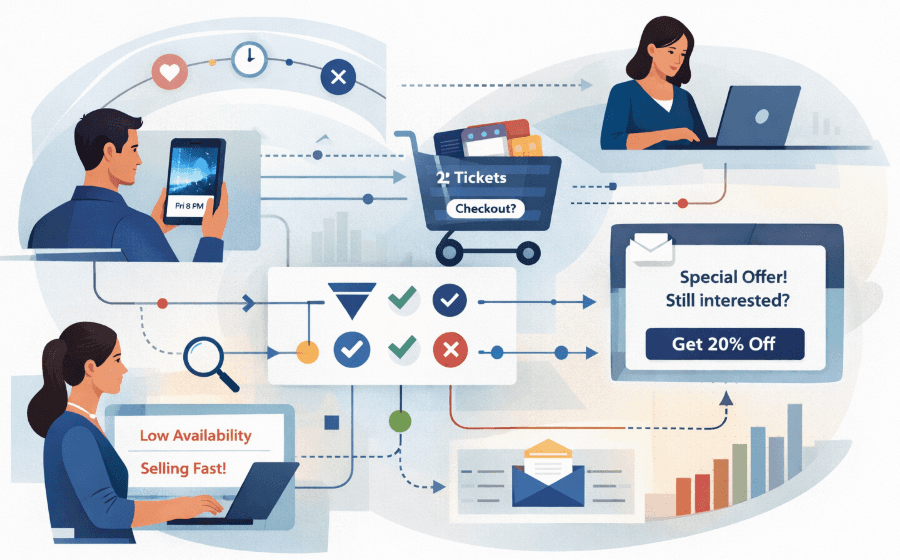
What real problems it solves in ticketing
Online ticket sales present specific challenges where AI can provide concrete value:
Purchase process abandonment: A significant percentage of users who start a purchase don't complete it. AI can identify abandonment patterns, determine the optimal moment to intervene, and personalize recovery messages based on specific user behavior.
Relevant communication: For recurring events, AI can analyze attendance history and preferences to send communications about events that actually interest each buyer, instead of generic mass mailings.
Purchase assistance: Chatbots with natural language processing capability can resolve specific questions about events, guide the purchase process, and reduce friction without human intervention.
Timing optimization: When a communication is sent affects its effectiveness. AI can analyze historical patterns to determine when each user is most likely to respond positively.
Real AI use cases in ticket sales
In the current ticketing context, AI is applied in concrete ways:
Intelligent remarketing: Systems that not only detect abandoned carts, but analyze user's previous behavior to determine what type of message to send, when to send it, and what content to include. This differs from traditional remarketing that sends the same message to everyone.
Communication content generation: AI that produces personalized texts for emails based on event type, buyer profile, and communication context. It's not generic content, but adapted to specific variables.
Purchase-oriented chatbots: Automated assistants that understand questions formulated in different ways, not just respond to exact keywords. They can guide the purchase process by answering questions about location, date, policies, and other event aspects.
Predictive segmentation: Buyer database analysis to identify who has the highest probability of interest in certain types of events, enabling more relevant communications.
Is AI use in sales being exaggerated?
Common promises that aren't delivered
The sales technology market presents claims that frequently don't withstand critical analysis:
"AI sells by itself": There's no AI system that completely replaces commercial strategy, product quality, or value proposition. AI optimizes processes, it doesn't create demand where none exists.
"Guaranteed results": The effectiveness of any AI system depends on multiple variables: data quality, operation volume, proper configuration, market context. No results are guaranteed.
"Zero configuration": Effective AI systems require data to learn. A new system, without history, can't operate with the same effectiveness as one with months or years of accumulated information.
"AI that understands everything": Current chatbots, even the most advanced ones, have limitations in contextual understanding and can fail in complex or unusual situations.
When AI isn't enough
There are situations where artificial intelligence doesn't solve the problem:
Low-demand events: If an event doesn't have market interest, no AI optimization will create buyers. AI improves conversion of existing interest, it doesn't generate interest where there isn't any.
Insufficient data: Organizers with few events or small databases don't have enough information for learning algorithms to work effectively.
Product problems: If the event has value proposition, location, date, or basic communication problems, AI doesn't compensate for these structural deficiencies.
Unrealistic expectations: Expecting AI to multiply sales without any other operational changes leads to frustration and incorrect technology evaluations.
What to consider when evaluating an AI sales solution
If you're considering incorporating AI into your ticket sales operation, this checklist helps evaluate options:
About the technology:
Does the system really use AI or is it traditional automation with updated marketing?
What type of algorithms does it use and for what specific functions?
Does the system learn and improve over time or execute fixed rules?
About the data:
Who owns the data generated by your operation?
Is data shared with other organizers or platform users?
Can you export your information without restrictions?
Does the system have access to enough data for AI to work effectively?
About implementation:
How much time does the system need to learn from your data?
What results are realistic to expect in the short term?
What configuration does it require from you?
About control:
Can you adjust how AI operates in your specific context?
Do you have visibility into what decisions the system makes and why?
Can you disable functionalities that don't serve you?
Why AI sales works better in white-label models
The effectiveness of any AI system depends on its access to data and its ability to act on it. White-label ticketing models present structural advantages for this.
Data control
In a white-label model, all buyer behavior information belongs to the organizer. This means:
Complete interaction history available for analysis
No data dilution between multiple organizers
Ability to build more accurate buyer profiles
Greater volume of proprietary data to train algorithms
In centralized platforms, data is mixed or distributed among multiple users, reducing effective personalization capability.
Brand identity
When AI generates communications (emails, remarketing messages, chatbot responses), these come out with the organizer's identity, not from a third-party platform. This affects:
Brand consistency in all automated interactions
Greater buyer trust when receiving communications
Direct relationship building between organizer and audience
Direct buyer relationship
The white-label model allows all interaction, including AI-mediated, to occur between organizer and buyer without visible intermediaries:
The chatbot responds as if it were from the organizer
Remarketing emails come from the organizer's domain
Communications build relationship with the event brand, not with a ticketing platform
This doesn't mean AI is technically better in one model or another, but that its application has greater impact when the organizer controls the entire experience and data.crear una plataforma marca blanca
Conclusion: AI as tool, not promise
AI-powered sales is an operational reality today, but with more modest scope than tech marketing suggests. In the ticket sales context, AI provides concrete value in remarketing, automated communication, purchase process assistance, and timing optimization.
However, it's not a magic solution. It requires sufficient data, proper configuration, and realistic expectations. It doesn't replace commercial strategy, doesn't create nonexistent demand, and doesn't guarantee results by itself.
For event organizers, the question isn't whether to use AI or not, but how to integrate it so it adds real value to their specific operation. This involves critically evaluating promises, understanding limitations, and prioritizing solutions that offer data control and operational transparency.
AI is a tool. Like any tool, its usefulness depends on how it's used, not on how many times it appears in a platform's sales pitch.tendencias ticketing 2025
Frequently asked questions
Is all sales automation artificial intelligence?
No. Traditional automation executes predefined rules (if X happens, do Y) identically every time. Artificial intelligence analyzes patterns, learns from results, and can modify its behavior based on historical data. Many solutions labeled as "AI" are actually conventional automations. The difference is whether the system learns and adapts, or simply executes fixed instructions.
Can AI sell tickets by itself?
No. AI optimizes existing sales processes but doesn't replace fundamentals: an event with clear value proposition, adequate communication, and market demand. AI improves efficiency and personalization but requires solid commercial foundations to be effective.
What payment methods work best with AI ticketing systems?
AI systems are payment-method agnostic but work best when they have access to complete transaction data. Stripe, credit cards, ACH, and Apple Pay all provide rich data streams that help AI algorithms understand buyer behavior and optimize the purchase funnel accordingly.
Tags