
La planificación profesional de eventos es lo que separa a los organizadores exitosos de los improvisados, transformando ideas en experiencias memorables a través de metodología clara y ejecución precisa. Cada evento requiere un proceso de 7 fases bien definidas, desde la conceptualización hasta el análisis post-evento, donde ningún detalle puede quedar librado al azar. El éxito no depende del presupuesto sino de la planificación estratégica, la gestión anticipada de riesgos y el control total de cada punto de contacto con los asistentes.
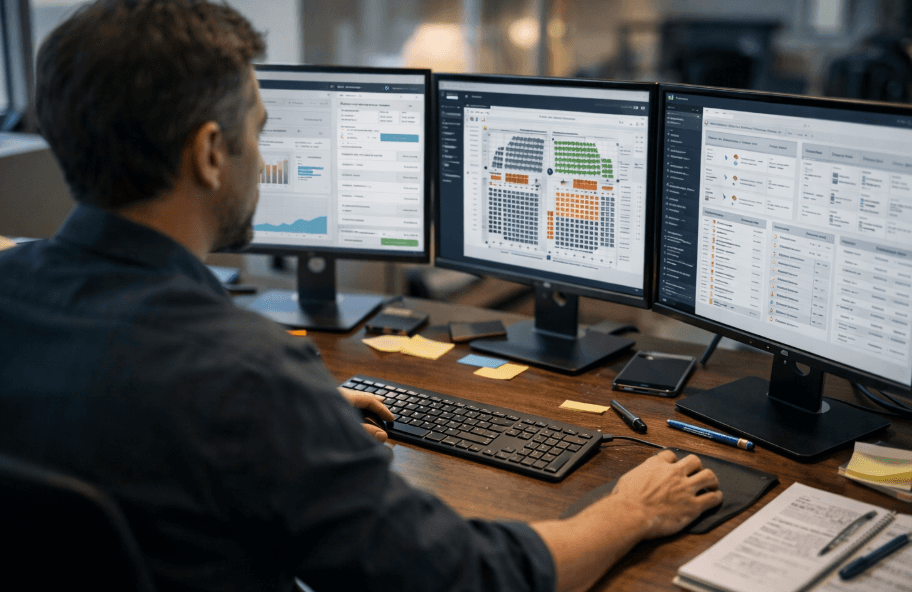
Event planning is the process that separates professional organizers from improvised ones. Whether you're preparing a massive concert, a theater production, a corporate conference, or a private party, every detail counts. And in the United States, where competition is fierce and expectations are high, planning ahead isn't a luxury: it's a necessity.
This guide will take you from the initial idea to post-event analysis. You'll find proven methodology, concrete tools, and practical tips you can apply starting today. Because organizing events can be chaotic, but it doesn't have to be.
What is event planning and why does it define success
Event planning is the set of decisions, tasks, and processes that transform an idea into a real experience. It involves defining objectives, managing resources, coordinating teams, anticipating problems, and executing every detail with precision.
But planning isn't simply making a to-do list. It's thinking strategically about every element of the event: from the creative concept to evacuation logistics, from pre-event communication to post-event follow-up with attendees.
A well-planned event shows. It flows. Attendees perceive that everything is in place, even if they don't know exactly why. In contrast, an improvised event creates friction: endless lines, confusing information, dead moments, frustrating experiences.
The real impact of good planning
When you plan an event correctly:
You reduce unnecessary costs by negotiating early and comparing options
You minimize operational risks by anticipating problematic scenarios
You improve the attendee experience at every touchpoint
You build professional reputation that generates future events
You obtain valuable data to optimize future editions
The difference between a successful event and a problematic one almost never lies in the budget. It lies in the planning.
Types of events that require professional planning
Each type of event has its own particularities, but all share the need for solid methodology. Understanding the differences helps you adapt your planning process.
Cultural and artistic events
Concerts, theater productions, festivals, exhibitions, and artistic presentations demand special attention to the sensory experience. Acoustics, lighting, stage timing, and crowd management are critical. In the US, this segment has grown significantly, especially with events like Coachella, SXSW, and Lollapalooza setting industry standards.
Corporate events
Conferences, product launches, training sessions, and business conventions prioritize effective communication and networking. They require reliable technology, functional spaces, and logistics that respect the time constraints of a professional audience.
Social events and celebrations
Weddings, quinceañeras, themed parties, and private celebrations have a very high emotional component. Here, personalization is key: every detail must reflect the identity of the person celebrating.
Sporting events
Marathons, tournaments, competitions, and sporting events combine complex logistics with strict safety protocols. Coordination with local authorities, medical services, and security forces is a fundamental part of planning.
Hybrid and virtual events
The combination of in-person and remote audiences adds a layer of technical complexity. Quality streaming, real-time interaction, and content adapted to each format are specific challenges of this modality.
The 7 phases of event planning
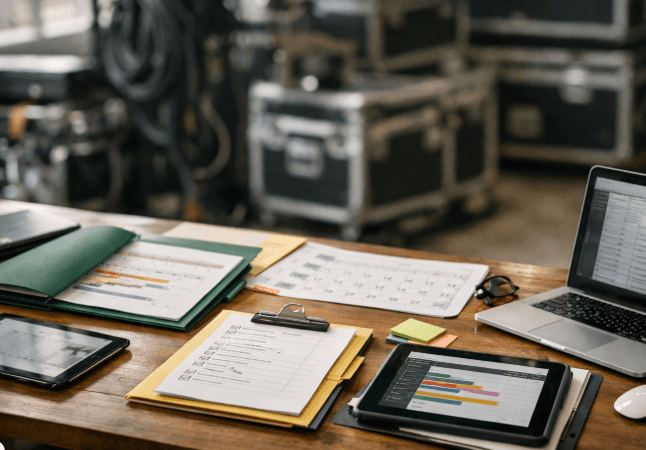
Every professional event goes through defined stages. Skipping any phase or executing it hastily always has consequences. This methodology allows you to advance in order and cover all fronts.
Phase 1: Defining objectives and concept
Before booking a venue or designing a flyer, you need to answer fundamental questions. This phase determines everything that follows.
Questions you must answer:
What is the purpose of the event? It could be fundraising, launching a product, celebrating, educating, entertaining, or building community.
Who is your target audience? Define age, interests, geographic location, and expectations.
What experience do you want attendees to take away? The memory you seek to create guides all decisions.
How will you measure success? Establish concrete indicators: number of attendees, satisfaction, revenue, media coverage.
The creative concept
With clear objectives, develop the event concept. This includes the name, visual identity, communication tone, and overall narrative. A strong concept differentiates your event and facilitates all subsequent decisions.
For example, it's not the same to organize "a music festival" as organizing "Electric Nights: 12 hours of music under the stars in Miami Beach." The second has concept; the first only has category.
Phase 2: Budget and resource management
The budget is your event's reality framework. No matter how ambitious your concept, the numbers determine what's possible.
Typical components of an event budget:
Venue rental typically represents 20% to 35% of the total budget, depending on location and venue characteristics. Technical production (sound, lighting, staging) can consume another 15% to 25%. Artistic talent or speakers vary enormously depending on the event profile. Communication and marketing demand 10% to 20% if you want to effectively reach your audience. Finally, contingencies should have a reserve of at least 10%.
Revenue sources
Events can be funded through ticket sales, sponsors, grants, merchandising, or combinations of these sources. Defining the revenue model early allows you to project viability and adjust the event's scope.
Continuous financial control
Keep a detailed record of every expense and income. Use shared spreadsheets that the entire team can access. Review the budget weekly during active planning and daily in the week prior to the event.
Phase 3: Logistics and vendor selection
Logistics is where event planning becomes tangible. Every logistical decision impacts the attendee experience and the day-of-event operation.
Venue selection
The physical space must align with your concept, your audience, and your budget. Consider actual capacity (not just legal), accessibility, nearby public transportation, available parking, current permits, and space flexibility for your specific setup.
In the US, visit each venue personally before confirming. Photos can be deceiving and contracts often have clauses you only discover by reading the fine print.
Key vendors
Build a network of reliable vendors for each area: catering, sound, lighting, security, cleaning, photography, transportation. Ask for references, review previous work, and establish clear communication channels.
For each vendor, define in writing the service scope, setup and breakdown schedules, specific responsibilities, and conditions for cancellation or changes.
Permits and authorizations
Depending on the type and size of the event, you'll need different municipal permits, fire department authorizations, liability insurance, and special permits. Start these processes months in advance because bureaucratic timelines are unpredictable.
Contingency plan
What happens if it rains? If the main sound system fails? If a vendor doesn't show up? Every identified risk needs a documented Plan B. The ability to resolve unexpected issues without the audience noticing is what distinguishes professionals.
Phase 4: Event communication and promotion
An excellent event with poor communication is an empty event. Promotion should begin weeks or months in advance, depending on scale, and maintain momentum until event day.
Communication strategy
Define the channels where your audience is: Instagram, TikTok, email, WhatsApp, traditional media, urban signage, or combinations. Each channel requires content adapted to its format and audience.
Build a communication timeline with clear milestones. The launch, ticket sales opening, artist or speaker announcements, last-chance alerts, and final reminders should be calendared.
Content that generates interest
Show behind-the-scenes, share testimonials from previous editions, introduce protagonists, generate expectation with exclusive previews. Valuable content builds community; purely promotional content drives it away.
Media relations
For events of certain scale, press work amplifies reach. Prepare a press kit with complete information, high-quality images, and clear contact information. Identify relevant journalists and media for your event type and build genuine relationships.
Phase 5: Ticket sales and attendee registration
Ticket sales are much more than an economic transaction. It's the first formal point of contact with your attendee and an invaluable source of data for your current event and future ones.
Defining categories and benefits
Structure your ticket offering thinking about different attendee profiles. Early birds for quick decision-makers, general admission, VIP access with differentiated benefits, group packages. Each category should have clear benefits that justify the difference.
The purchase experience
The purchase process should be simple, fast, and secure. In the US, integration with Stripe for credit card processing and ACH payments is essential, along with Apple Pay for mobile convenience. Any friction at this point (slow pages, confusing steps, limited payment methods) translates to lost sales.
Control over your data
A critical aspect many organizers neglect is ownership of buyer data. When you sell through generic third-party platforms, that data stays with the platform, not with you. This limits your ability to communicate with your audience after the event or in future editions.
Platforms like Fanz allow you to sell tickets from your own domain, maintaining total control of your buyer database and collecting directly in your Stripe account. This white-label ticketing model positions you as the owner of your audience, not as an intermediary for someone else's platform.
Access management on event day
Define how you'll validate tickets at entry. QR code systems speed up lines and reduce errors. Train accreditation staff and have clear protocols for special situations: duplicate tickets, buyers without ID, last-minute transfers.
Phase 6: Event execution
Event day is when all your planning work is put to the test. The key is having clear systems and a prepared team.
Operational timeline
Document every moment of the event with assigned responsibilities. From door opening to closing, including stage changes, breaks, key moments. Everyone involved should have access to this timeline.
Internal communication
Establish clear communication channels between all teams. Radios, dedicated WhatsApp groups, or specific apps. Define who makes decisions in case of unexpected issues and how problems are escalated.
Attendee experience at every touchpoint
Think about the complete attendee journey: arrival, entry, location, consumption, participation, exit. Every moment is an opportunity to add value or generate frustration. Clear signage, friendly staff, accessible information.
Event documentation
Professional photography and video aren't luxuries; they're investments. Content generated during the event feeds your future communication, demonstrates your capability to potential sponsors, and builds your archive as an organizer brand.
Phase 7: Post-event and results analysis
The event is over, but your work as a professional organizer continues. This phase is usually the most neglected and also the one with the greatest impact on your growth.
Operational and financial closure
Complete pending payments to vendors, collect invoices, close the final event balance. Document deviations from the original budget to learn from them.
Metrics analysis
Review the indicators you defined at the beginning. Did you meet the attendance goal? How was the sales distribution over time? Which communication channels generated the most conversions? What was the actual cost per attendee compared to projections?
Attendee feedback
Send satisfaction surveys while the experience is still fresh. Ask about specific aspects: venue, content, organization, value for money. This feedback is gold for improving future editions.
Team debriefing
Meet with your team to analyze what worked and what didn't. Document lessons learned, identify process improvements, recognize outstanding performances. This institutional memory is what allows you to grow as an organizer.
Relationship building for the future
Thank attendees, sponsors, vendors, and collaborators. Maintain relationships with key contacts. Plan follow-up communication for future events. Professional event organizing is a relationship business, and these connections are your most valuable asset.
Essential tools for professional event planning
The right tools can make the difference between organized and chaotic planning. Here are the categories you should consider:
Project management and organization
Trello or Asana for task management and team collaboration. Create boards for each phase of planning with clear deadlines and responsibilities.
Google Workspace or Microsoft 365 for document sharing, calendars, and real-time collaboration.
Slack for team communication, especially for distributed teams working on the same event.
Financial management
QuickBooks or FreshBooks for complete financial management, from budgeting to final accounting.
Google Sheets or Excel for detailed budget tracking and financial projections.
Marketing and communication
Hootsuite or Buffer for social media management and content scheduling.
Mailchimp or Constant Contact for email marketing and communication with your attendee database.
Canva or Adobe Creative Suite for creating promotional graphics and visual materials.
Ticketing and attendee management
White-label platforms like Fanz that allow you to sell from your domain while maintaining control of your data.
CRM systems for managing relationships with sponsors, vendors, and key attendees.
Event day management
Event management apps for real-time coordination between teams.
QR code scanners for fast and efficient access control.
Radio communication systems for large teams and extensive venues.
Common mistakes and how to avoid them
Learning from others' mistakes is cheaper than learning from your own. Here are the most frequent errors in event planning and how to prevent them:
Starting too late
The mistake: Thinking that two months is enough to organize a professional event.
The consequence: Limited venue options, higher costs, rushed decisions, technical problems.
The solution: Start planning at least 4-6 months in advance for medium events, 8-12 months for large events.
Underestimating the budget
The mistake: Not including all categories of expenses or underestimating real costs.
The consequence: Running out of money mid-planning, compromising event quality.
The solution: Research real market costs, include a 10-15% contingency, control the budget weekly.
Neglecting contingency planning
The mistake: Assuming everything will go according to plan.
The consequence: Panic and improvisation when problems arise.
The solution: Identify possible risks and have a documented Plan B for each one.
Poor vendor communication
The mistake: Assuming vendors know what you expect without clear communication.
The consequence: Unpleasant surprises on event day, services that don't meet expectations.
The solution: Document everything in writing, have regular check-in meetings, confirm details the week before.
Ignoring the attendee experience
The mistake: Focusing only on logistics and forgetting about the attendee journey.
The consequence: Technically functional events but emotionally unsatisfying.
The solution: Map the complete attendee experience and optimize each touchpoint.
Not documenting the process
The mistake: Relying on memory to remember what worked and what didn't.
The consequence: Repeating the same mistakes in future events, not capitalizing on successes.
The solution: Keep detailed records of decisions, costs, vendors, and results.
Measuring event success: Key metrics
What you don't measure, you can't improve. Defining success metrics from the beginning allows you to make informed decisions and demonstrate the value of your work.
Quantitative metrics
Attendance
- Total attendees vs. planned capacity
- Ticket conversion rate (visitors to buyers)
- No-show percentage
- Sales distribution over time
Financial
- Total revenue vs. budget
- Cost per attendee
- Profit margin
- Return on investment (ROI)
Marketing
- Reach and engagement on social media
- Email open and click rates
- Media mentions and coverage value
- Traffic to event website
Qualitative metrics
Attendee satisfaction
- Post-event surveys (aim for Net Promoter Score above 50)
- Comments and reviews on social media
- Spontaneous testimonials
Team performance
- Adherence to planned timeline
- Incident resolution efficiency
- Post-event team feedback
Strategic impact
- Achievement of original objectives
- Generated business opportunities
- Strengthened relationships
- Brand positioning improvement
The future of event planning: Trends for 2025
The event industry constantly evolves. Understanding emerging trends helps you stay relevant and offer experiences that exceed attendee expectations.
Technology and personalization
Artificial intelligence is beginning to personalize event experiences in real-time. From recommending networking contacts to suggesting sessions based on interests, technology enables hyper-personalized experiences.
Event apps with advanced features (real-time chat, personalized agendas, augmented reality) are becoming standard, not luxuries.
Sustainability and social responsibility
Attendees increasingly value events that demonstrate environmental and social commitment. Carbon-neutral events, local suppliers, waste reduction, and social causes are becoming differentiating factors.
Hybrid experiences
The combination of in-person and virtual isn't temporary; it's the new normal. Events that successfully integrate both audiences create more inclusive and accessible experiences.
Immersive experiences
Virtual reality, augmented reality, and other immersive technologies are creating new forms of engagement and participation in events.
Data and analytics
Real-time data analysis during events allows for immediate adjustments and continuous optimization of the attendee experience.
Conclusion: Professional event planning as competitive advantage
In a world where experiences matter more than products, professional event planning becomes a crucial competitive advantage. It's not just about organizing activities; it's about creating memorable moments that build lasting relationships.
Every successful event starts with solid planning. Every detail matters, every decision has consequences, and every phase has its importance. But perhaps most important is understanding that event planning is ultimately about people: understanding them, serving them, and creating experiences they want to repeat and recommend.
The methodology, tools, and strategies presented in this guide provide you with a solid foundation. But professional event planning is learned by doing, failing, learning, and improving. Each event is an opportunity to refine your process and build your reputation.
Start with clear objectives, plan with methodology, execute with precision, and measure with rigor. Most importantly, never forget that behind every ticket is a person with expectations, emotions, and the desire to live something special.
Because at the end of the day, events are not about logistics or budgets or vendors. They are about moments that remain in memory, connections that are created, and experiences that transform people. And that, ultimately, is what professional event planning is about.
¿Qué es la planificación de eventos y por qué es tan importante para el éxito?
La planificación de eventos es el conjunto de decisiones, tareas y procesos que transforman una idea en una experiencia real. Implica definir objetivos, gestionar recursos, coordinar equipos, anticipar problemas y ejecutar cada detalle con precisión. No es simplemente hacer una lista de tareas, sino pensar estratégicamente sobre cada elemento del evento: desde el concepto creativo hasta la logística de evacuación. Un evento bien planificado fluye naturalmente y los asistentes perciben que todo está en su lugar, mientras que un evento improvisado crea fricción con filas interminables, información confusa y experiencias frustrantes. La diferencia entre un evento exitoso y uno problemático casi nunca está en el presupuesto, sino en la planificación.
¿Cuáles son las 7 fases principales de la planificación de eventos profesional?
Las 7 fases de la planificación de eventos son: 1) Definición de objetivos y concepto - establecer el propósito, audiencia objetivo y experiencia deseada; 2) Presupuesto y gestión de recursos - crear el marco financiero realista; 3) Logística y selección de proveedores - elegir venue, vendors y obtener permisos; 4) Comunicación y promoción del evento - desarrollar estrategia de marketing y construir audiencia; 5) Venta de entradas y registro de asistentes - estructurar categorías de tickets y gestionar la experiencia de compra; 6) Ejecución del evento - coordinar todas las operaciones el día del evento; 7) Post-evento y análisis de resultados - evaluar métricas, recopilar feedback y documentar lecciones aprendidas. Cada fase es fundamental y saltarse alguna siempre tiene consecuencias.
¿Cómo debe estructurarse el presupuesto de un evento profesional?
El presupuesto de un evento típicamente se distribuye de la siguiente manera: el alquiler del venue representa entre 20% y 35% del presupuesto total, dependiendo de la ubicación y características del lugar. La producción técnica (sonido, iluminación, escenografía) puede consumir otro 15% a 25%. El talento artístico o speakers varía enormemente según el perfil del evento. La comunicación y marketing demandan 10% a 20% si querés llegar efectivamente a tu audiencia. Finalmente, las contingencias deben tener una reserva de al menos 10%. Es fundamental mantener un control financiero continuo usando planillas compartidas que todo el equipo pueda acceder, revisar el presupuesto semanalmente durante la planificación activa y diariamente en la semana previa al evento.
¿Qué herramientas son esenciales para la planificación profesional de eventos?
Las herramientas esenciales se dividen en varias categorías: Para gestión de proyectos necesitás Trello o Asana para manejo de tareas y colaboración en equipo, Google Workspace o Microsoft 365 para compartir documentos y calendarios, y Slack para comunicación del equipo. Para gestión financiera, QuickBooks o FreshBooks para contabilidad completa, y Google Sheets o Excel para seguimiento detallado del presupuesto. Para marketing: Hootsuite o Buffer para redes sociales, Mailchimp o Constant Contact para email marketing, y Canva o Adobe Creative Suite para materiales gráficos. Para ticketing: plataformas white-label como Fanz que permiten vender desde tu dominio manteniendo control de tu data. Para el día del evento: apps de gestión, escáneres QR para control de acceso y sistemas de comunicación por radio para equipos grandes.
¿Cuáles son los errores más comunes en la planificación de eventos y cómo evitarlos?
Los errores más frecuentes incluyen: Empezar demasiado tarde - muchos piensan que dos meses son suficientes, pero necesitás al menos 4-6 meses para eventos medianos y 8-12 meses para eventos grandes. Subestimar el presupuesto - no incluir todas las categorías de gastos o subestimar costos reales; la solución es investigar costos reales del mercado e incluir 10-15% de contingencia. Descuidar la planificación de contingencias - asumir que todo saldrá según el plan; identificá riesgos posibles y tené un Plan B documentado para cada uno. Mala comunicación con proveedores - asumir que saben qué esperás sin comunicación clara; documentá todo por escrito y confirmá detalles la semana anterior. Ignorar la experiencia del asistente - enfocarse solo en logística; mapeá la experiencia completa del asistente y optimizá cada punto de contacto.
¿Qué métricas son clave para medir el éxito de un evento?
Las métricas se dividen en cuantitativas y cualitativas. Las cuantitativas incluyen: Asistencia (total de asistentes vs capacidad planificada, tasa de conversión de visitantes a compradores, porcentaje de no-shows), métricas financieras (ingresos totales vs presupuesto, costo por asistente, margen de ganancia, ROI), y marketing (alcance y engagement en redes sociales, tasas de apertura de emails, menciones en medios). Las cualitativas abarcan: satisfacción del asistente mediante encuestas post-evento (apuntá a un Net Promoter Score superior a 50), comentarios en redes sociales, desempeño del equipo evaluando adherencia al cronograma planificado, e impacto estratégico midiendo el logro de objetivos originales, oportunidades de negocio generadas y fortalecimiento de relaciones. Lo que no se mide, no se puede mejorar.
Tags